

May 5, 2022
Contents
Finding the right water heater is crucial for living comfortably in your home. Making sure your water heater can provide hot water for all your household needs at a reasonable cost can save your family money and energy. On average, water heating accounts for 14-18% of your utility bill, making it the second-largest expense for your home.
Choosing the right tank and performing regular maintenance and inspections ensures your household has the hot water it needs.
How to Determine What Size Water Heater You Need
While exploring water heater options, there are four features to think about before you buy. Consider the following:
- Fuel: What fuel sources are available in your area — natural gas, propane, electric, solar, geothermal? Not every site has access to all types of energy. Depending on your location, some fuels will be more expensive than others.
- Costs: What’s your budget? Estimating the purchase and operating costs of heaters beforehand lets you choose the best fit for your budget. Costs include fuel type, tank size, installation costs, maintenance fees and other accommodations down the line.
- Size: Examine your water usage and estimate the size of tank you’ll need to meet your hot water requirements for a day. If it’s too small, you’ll run out of hot water during peak hours of use. If it’s too large, you’ll spend more money on a unit you don’t need.
- Efficiency: Different styles of heaters have different energy efficiencies. Check EnergyStar ratings and fuel availability to work out the most energy-efficient heater for your house.
How Big of a Water Tank Do You Need?
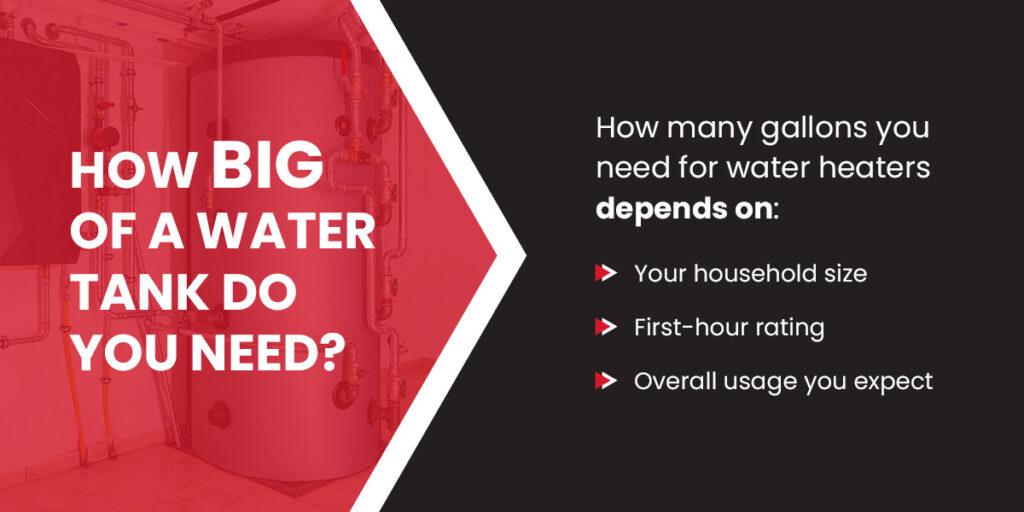
In choosing the right fuel and tank for your household, you also need to decide what hot water tank sizing will best meet your family’s water requirements. Sizes of hot water tanks range from 20 to 80 gallons, but typically come in 30, 40, 50, 55 and 75 size categories.
A 40- or 50-gallon heater is the recommended minimum for a standard household. Smaller sizes are less common. For reference, a mobile home may be shipped with a 30-gallon water heater, which isn’t enough to fill a standard bathtub.
How many gallons you need for water heaters depends on your household size, the first-hour rating and the overall usage you expect.
Household Size
Identifying the number of people in a household is the first step in figuring out how big of a water tank you need. You’ll need to consider each family member’s daily activities that use hot water, such as showering, bathing, washing dishes and doing the laundry.
A heater that’s too small will leave some people in the house taking cold showers. Conversely, an oversized one will cause a spike in your energy bills, costing you unnecessarily.
That said, getting a slightly larger heater than you expect to need may be worth it if you have the space. Giving yourself some breathing room is always a good idea, as some days water consumption will be higher — like when you have guests. A larger heater can also help in the future if you’re building your family or planning to upgrade your home and install new appliances later.
First-Hour Rating
Not all hours of the day are the same regarding how much water family members use. Peak water usage hours happen when people use multiple appliances at once — usually in the morning, before work and school, and in the evening. Ensuring your heater can deliver during these demand periods is vital. The first-hour rating (FHR), which you can find on the EnergyGuide label, will help you determine if your chosen heater is suitable for your peak hour usage.
FHR measures how much hot water a traditional storage heater can provide in its first hour of use after its tank is full and the element has heated it to the desired temperature. You’ll need to work out how much you use during peak times by listing the appliances in use, estimating the gallons of water that each activity and appliance will need, and adding them together to get your peak use demand. You can then compare this to the FHR rating.
Overall Usage
You can estimate your overall daily usage by considering the number of people and appliances in your house.
For example, let’s say there are two people in your household. You have a shower, dishwasher, two sinks with hot water faucets, and a washing machine.
For the appliances, you can look at the product specifications or the user manual, which often has the number of gallons per cycle. You can find the flow rate for the shower, measured in gallons per minute, on the shower head or in the manual. To get an educated estimation, multiply the flow rate by the shower duration, and you’ll get your water usage.
Once you have these figures, add them up to determine one person’s daily usage. Then, multiply this number by household size. Add 10 gallons for breathing room, and you’ll have a good idea of how many gallons your water heater needs.
Water Heater Capacities
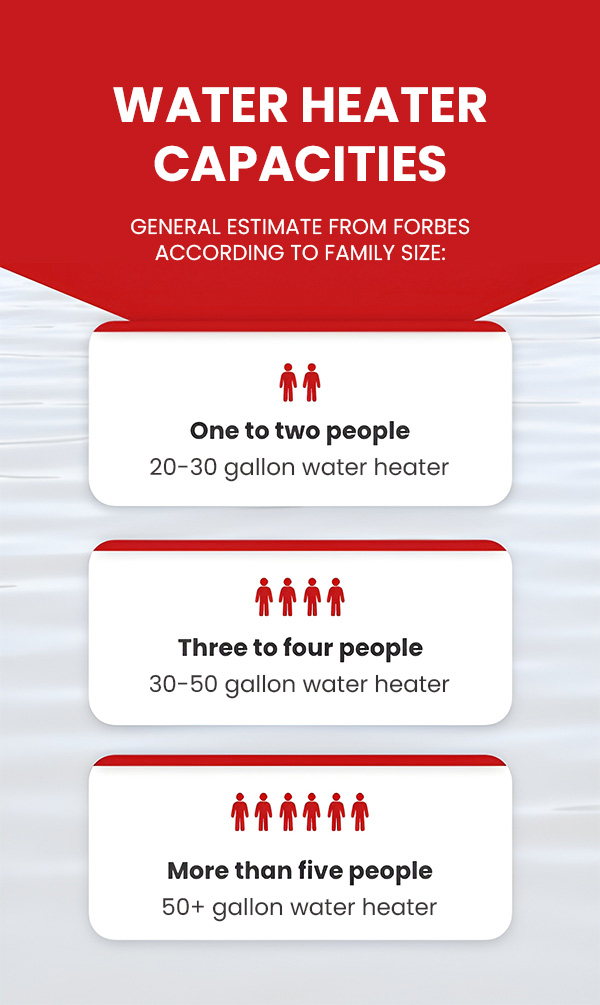
The following table is a general estimate from Forbes for water heater capacities according to family size:
| Recommended Water heater capacity | |
|---|---|
| Family size | Water heater capacity |
| One to two people | 20-30 gallon water heater |
| Three to four people | 30-50 gallon water heater |
| More than five people | 50+ gallon water heater |
The amount of water usage varies by household and location. It also depends on the type of heater you’ve selected.
Choosing the Right Water Heater for Your Requirements
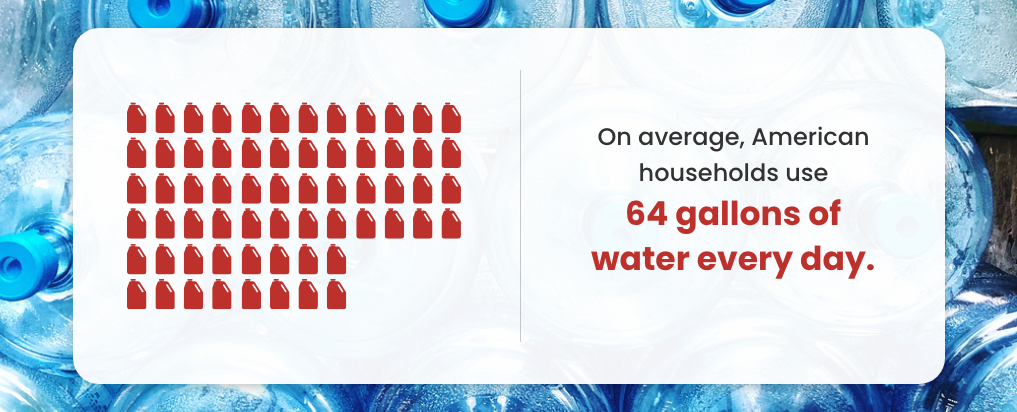
On average, American households use 64 gallons of water every day. Selecting the best water heater for your home saves you water, energy and other expenses. Generally, you’ll find four types of water heaters.
1. Storage
Storage heaters are one of the most common household water tanks and can keep around 20-80 gallons of hot water ready for use at any time. They’re relatively low-cost and can run on electricity, propane, natural gas and fuel oil.
Storage tanks experience heat loss, which reduces their energy efficiency. Since water in the tank is constantly heated until it reaches the set temperature, standby heat loss is unavoidable when water isn’t in use. Insulating your tank can help with this issue.
2. Tankless
Tankless models heat water on damand without needing a storage tank using natural gas or electricity. These heaters generally provide 7 to 12 gallons of hot water per minute and are much smaller than storage tanks. Because tankless heaters don’t have a store of hot water, models are chosen based on their flow rate rather than their tank capacity, so the size of the tankless water heater you need is measured according to flow rate.
The tankless nature of these heaters means they can’t always heat enough water for multiple appliances running at once. Installing separate tankless water heaters for different devices in your home can solve this, but also increase the purchase and installation costs.
Tankless heaters are more of an investment upfront than storage tanks, but have longer lifespans and lower energy and operational costs.
3. Hybrid
Hybrid water heaters use electricity to pull heat in from surrounding air and transfer it to a storage tank.
This technology makes them much more efficient than storage heaters, but they can only be used in spaces where temperatures are 40-90 degrees Fahrenheit year-round. Heat pump water heaters are more of an investment than storage heaters and have similar lifespans. However, the increased efficiency of hybrid heaters reduces the yearly cost of ownership and makes them less costly to operate.
Starting May 6, 2029, federal manufacturing standards will require most new electric storage water heaters in common sizes to meet hybrid efficiency levels. If you’re choosing an electric tank, selecting a heat pump model now can help you align with upcoming standards.
4. Solar
Solar heaters can have either active or passive heating systems and typically require the household to have an insulated solar storage tank.
Solar has expensive upfront costs, and household location and local building codes often limit its use, but it’s much more efficient than other water heaters. They also generally require a backup heating system, like a storage heater, for cloudy days. However, solar heating is 50% more efficient than gas or electric water heaters and has a longer life expectancy.
Contact Enduric Plumbing for Winston-Salem Water Heating Services
At Enduric Plumbing, we understand the importance of properly maintaining and installing water heaters in your home. Our experienced plumbing contractors are dedicated, friendly professionals who deliver quality work with excellent customer service. We offer full-service, friendly and professional residential and commercial plumbing services and deliver exceptional results that endure the test of time. Get in touch with our experts today, and we’ll help you determine your commercial or residential water heater sizing.